 |
 |
Editor: Dr Tim Harding |
 |
 |
 |
 |
 |
 |
|
|
Editor: Dr Tim Harding |
|
|
|
|
|
|
© Dr Tim Harding
Last modified:
13 October 2026

The first round was played on the 5th of August and there are five games with discrepancies between the tournament books and one case where the score in the official book was ambiguous.
We leave the most complicated case (Schlechter-Pollock) to the end of the article. Note that we have rewritten that one after finding further evidence confirming our original conclusion.
ChessBase’s Mega Database gives the score as follows: 1.e4 e5 2.Nc3 Nc6 3.Bc4 d6 4.d3 g6 5.f4 Na5 6.Bb3 Nxb3 7.axb3 Bg7 8.Nf3 Ne7 9.0–0 0–0 10.fxe5 dxe5 11.Be3 Re8 12.Qd2 Nc6 13.Bg5 f6 14.Bh4 Be6 15.Rf2 Qd7 16.Raf1 Rf8 17.Bg3 Rad8 18.h3 Rf7 19.Qe1 Bf8 20.Re2 a6 21.Kh2 Bh6 22.Na4 b6 23.Nc3 Re8 24.Kg1 Bg7 25.Nd1 Rfe7 26.Bh4 Rf7 27.Ne3 Ne7 28.Nh2 Ref8 29.Ref2 Nc6 30.Nf3 g5 31.Bg3 h5 32.Nh2 h4 33.Bxh4 gxh4 34.Nf3 f5 35.Ng5 f4 36.Nd5 Bxd5 37.exd5 Qxd5 38.Nxf7 Rxf7 39.Qe2 Nd4 40.Qe4 Qxe4 41.dxe4 Bf8 42.b4 Ne6 43.c3 c5 44.b5 axb5 45.Rd2 Kg7 46.Rd5 Kf6 47.Kf2 c4 48.Rxb5 Bc5+ 0–1.
The diagram shows the position after Black's 29...Nc6. The issue arises at White’s 30th move. Teichmann moved his knight from g2 - but to which square?
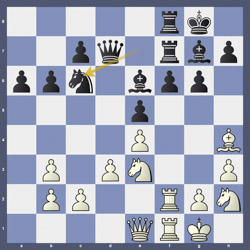
Using the descriptive notation, Cheshire (pp.17-18) has 30 Kt (R2) to B3. Crouch and Haines did comment on this case, pointing out that White’s 32nd move is a losing blunder. They preferred Schallopp’s version with 30 Nhg4, which is also a blunder losing a piece, but he thought it more plausible and so did the modern editors.
My conclusion: The internal evidence does not settle the question, so in the absence of any primary source supporting Schallopp’s version, we have to stay with the official record.
1.e4 .e5 2.f4 Bc5 3.Nf3 d6 4.Bc4 Nc6 5.Nc3 Nf6 6.d3 Bg4 7.h3 Bxf3 8.Qxf3 Nd4 9.Qg3 Nxc2+ 10.Kd1 Nxa1 11.Qxg7 Kd7 12.fxe5 dxe5 13.Rf1 Be7 14.Qxf7 .Kc8 15.Bg5 Rf8 16.Qe6+ Kb8 17.Bh6 Re8 18.Qxe5 Nd7 19.Qh5 Nb6 20.Bd5 a6 21.Kd2 Nxd5 22.Nxd5 Rg8 23.g4 Bb4+ 24.Nxb4 Qd4 25.Nc2 Nxc2 26.Kxc2 Rg6 27.Bd2 Rd6 28.Rf3 Qa4+ 29.Kc1 Qxa2 30.Bc3 Rc6 31.Qxh7 b5 32.Qe7 Qb3 33.Kd2 a5 34.Rf5 Kb7 35.Rc5 Raa6 36.g5 Rxc5 37.Qxc5 Rc6 38.Qd5 Qa4 39.g6 b4 40.g7! bxc3+ 41.bxc3 Qa1 42.g8Q Qxc3+ 43.Ke2 Qc2+ 44.Kf3 Qd1+ 45.Kg3 Qg1+ 46.Kh4 Qf2+ 47.Kh5 Qf3+ 48.Qg4 Qf6 49.Qgf5 Qh6+ 50.Kg4 Qg7+ 51.Qg5 1–0
The diagram shows the position after White's 41 bxc3. Pillsbury moved his queen - but to which square?
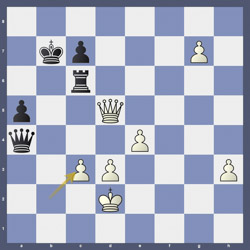
Cheshire (pp20-22) has 41…Q to R6 (i.e.,Qa3) which was also in The Times of 8 August. British Chess Magazine, September 1895 (pp. 383-384) had notes by the Rev. Charles Ranken, a prominent English amateur who annotated several games for the magazine. His version had 41…Q-R8 (i.e., 41…Qa1). The Field, 10 August 1895 (starting at move 21) had “Q to R8” Schallopp (pp65-67), the ChessBase Mega Database, Crouch/Haines (pp40-44) and Pickard also all have 41…Qa1, which seems right?
Conclusion: In this game the move in the Cheshire tournament book was wrong and we accept the correction 41...Qa1.
ChessBase’s Mega Database gives the score as follows, 1.Nf3 f5 2.b3 Nf6 3.Bb2 e6 4.e3 Be7 5.Nc3 b6 6.d4 Bb7 7.Bd3 0–0 8.0–0 Qe8 9.Ne2 Nc6 10.c4 Nd8 11.Nf4 Bd6 12.Ne5 Nf7 13.Be2 Bxe5 14.dxe5 Ne4 15.f3 Nc5 16.b4 Na6 17.Qd2 Qe7 18.a3 c5 19.Rad1 Rfd8 20.b5 Nc7 21.Qc3 Nh8 22.Kh1 Ng6 23.Rg1 Rf8 24.Rd2 Rf7 25.Rgd1 Rd8 26.Rd6 Nxf4 27.exf4 Ne8 28.R6d2 g6 29.a4 Ng7 30.a5 Qh4 31.g3 Qh6 32.axb6 axb6 33.Rd6 g5 34.Rxb6 gxf4 35.Bc1 Nh5 36.Rg1 Rb8 37.Rd6 Rg7 38.Rg2 Kh8 39.Qe1 Rbg8 40.Kg1 fxg3 41.Bxh6 gxh2+ 42.Kxh2 Rxg2+ 43.Kh3 R2g6 44.Be3 f4 45.Bf2 Rh6 46.Bh4 Ng3 47.Rxd7 Nxe2 48.Rd8 Rxd8 49.Kg2 Rg8+ 50.Kf2 Rxh4 51.Kxe2 Rh3 52.Qc3 Bxf3+ 0–1
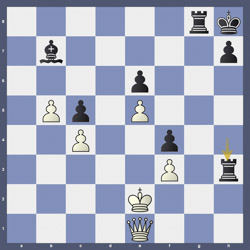
The issue here is: what was White’s 52nd move? Cheshire (pp22-24) had 52 Q to R5 (i.e., Qa5) as did the Morning Post, 7 August, and Wayte in the September BCM (pages 388-389). Schallopp (pp53-55), Crouch (pp48-49), Pickard all have 52 Qe1-c3 instead. Hans Renette’s book on Bird gives Qc3 but notes the alternative. Which is more plausible? Black has forced mate in either case (but it is quicker after Qc3).
Conclusion: Certainty is impossible but there seems insufficient evidence to replace Qa5 by Qc3 so we disagree with ChessBase and will put 52 Qa5 in our database unless stronger arguments to the contrary can be found.
ChessBase’s Mega Database gives the score as follows, 1.e4 e5 2.Nf3 Nc6 3.Nc3 a6 4.d4 exd4 5.Nxd4 Nge7 6.Bc4 b5 7.Bb3 Nxd4 8.Qxd4 d6 9.Qe3 Bb7 10.Qf3 f6 11.Bf4 Ng6 12.0–0–0 Qd7 13.Bg3 0–0–0 14.Qe3 Re8 15.Qa7 Ne7 16.Rhe1 Nc6 17.Qe3 h5 18.f4 h4 19.Bf2 g6 20.Nd5 Bg7 21.h3 f5 22.Qd3 fxe4 23.Rxe4 Rxe4 24.Qxe4 Qf5 25.Qe3 Kb8 26.Kb1 Qh5 27.c3 Bh6 28.a4 g5 29.axb5 gxf4 30.Qd3 axb5 31.Nxc7 Rd8 32.Nxb5 Ba6 33.Bd5 Qe8 34.c4 Bxb5 35.cxb5 Nb4 36.Ba7+ 1–0
Niessen’s software noted that moves 6B-8W were swapped. Cheshire (pp. 26-27) has 6…Kt x Kt and Pickard copies (6…Nxd4 7 Qxd4 b5 8 Bb3) but Schallopp (pp59-60) has the version 6…b5, transposing and Crouch followed that. There is also a move order discrepancy at Black's 29th where Cheshire gave 29…axb5 30 Qd3 gxf4 with Schallopp transposing Black's 29th and 30th moves.
Conclusion: In both cases it is hard to decide which sequence is more plausible but, once more, there seems to be insufficient evidence to reject the official English tournament book version. So the correct record of this game is as follows: 1.e4 e5 2.Nf3 Nc6 3.Nc3 a6 4.d4 exd4 5.Nxd4 Nge7 6.Bc4 Nxd4 7.Qxd4 b5 8.Bb3 d6 9.Qe3 Bb7 10.Qf3 f6 11.Bf4 Ng6 12.0–0–0 Qd7 13.Bg3 0–0–0 14.Qe3 Re8 15.Qa7 Ne7 16.Rhe1 Nc6 17.Qe3 h5 18.f4 h4 19.Bf2 g6 20.Nd5 Bg7 21.h3 f5 22.Qd3 Rxe4 23.Rxe4 fxe4 24.Qxe4 Qf5 25.Qe3 Kb8 26.Kb1 Qh5 27.c3 Bh6 28.a4 g5 29.axb5 axb5 30.Qd3 gxf4 31.Nxc7 Rd8 32.Nxb5 Ba6 33.Bd5 Qe8 34.c4 Bxb5 35.cxb5 Nb4 36.Ba7+ 1–0
ChessBase’s Mega Database gives the score as follows, 1.d4 d5 2.c4 e6 3.Nc3 Nf6 4.Nf3 Be7 5.e3 0–0 6.Be2 dxc4 7.0–0 c5 8.dxc5 Bxc5 9.Bxc4 a6 10.Qe2 b5 11.Bb3 Bb7 12.Bd2 Nbd7 13.Rfd1 Qe7 14.Be1 b4 15.Na4 Bd6 16.Qd3 Bb8 17.Rac1 Bxf3 18.gxf3 Ne5 19.Qe2 g5 20.Rd4 a5 21.f4 gxf4 22.Rxf4 Kh8 23.f3 Nh5 24.Rd4 Ba7 25.Bh4 Qb7 26.Re4 f5 27.Rxe5 Qg7+ 28.Kh1 Qxe5 29.Rc6 Ng7 30.Bf2 Rad8 31.Nb6 Bxb6 32.Rxb6 Qc5 33.e4 Qc1+ 34.Be1 fxe4 35.Qxe4 Rf4 36.Qe2 Rdf8 37.Kg2 Rxf3 38.Qe5 a4 39.Bxa4 Qc4 40.Bb5 Qg4+ 0–1
This game was annotated by Tinsley for the Cheshire tournament book, pages 13-14. The Niessen software did not detect any difference between the PGNs but we noted that. "39…Q to B5" in Cheshire is ambiguous; it could mean …Qc4 or …Qf4. Schallopp, Crouch and Pickard all have 39…Qc4, as does Forster's book on Burn without comment. John Saunders in Britbase pointed out that Qf4 would allows White back into the game by exchanging queens.
Conclusion: 39…Qc4 must be correct.
This was the most difficult case to decide in this round. Our initial reaction (to prefer Schlechter’s version) proved doubtful.
Chess historian Olimpiu Urcan found this game in Pollock's column for the Baltimore Sunday News, 31 August 1895 (see his biography of Pollock, pages 426-427) and this source is decisive for preferring the longer version.
The course of the game in Schlechter’s column, Schallopp’s book and many other places was given as follows:
1 e4 e5 2 Nf3 Nc6 3 Bb5 a6 4 Ba4 Nf6 5 Nc3 Bb4 6 Nd5 Bc5 7 d3 h6 8 Be3 Bxe3 9 fxe3 d6 10 0–0 Be6 11 Nxf6+ Qxf6 12 Nd4 Qg5 13 Nxc6 Qxe3+ 14 Kh1 Bd7 15 Nxe5 Bxa4 16 Nxf7 0–0 17 Qh5 Be8 18 Rf3 Bxf7 19 Qxf7+ Rxf7 20 Rxe3 Rf2 21 Rae1 Raf8 22 Kg1 Rxc2 23 R3e2 Rxe2 24 Rxe2. Yet in Cheshire (pp16-17) the following additional moves were included 24...Rf4 25.Rc2 c6 26.Rc3 Kh7 27.g3 Rf7 28.Kg2 Kg6 29.d4 Kf6 30.Kf3 Ke6+ 31.Ke3 Rf1 32.Rc2 Re1+ 33.Kd3 Rd1+ 34.Ke3 Re1+ 35.Kd3 Rd1+ 36.Ke3 Re1+ ½–½.
The Deutsches Wochenschach of 11 August, like some of the English newspapers, said Schlechter soon gained an advantage but in the end he had to give it up and the game ended in a draw. Its issue for 3rd November 1895 (possibly Schallopp’s source) published the game with light notes up to White's 24th move only, as did Schlechter’s own column in the Vienna newspaper Allgemeine Sportzeitung (13 Oct 1895) which said “Remis” after 24 Rxe2.Crouch/Haines (pp46-47) and Pickard also stop at 24 Rxe2 and so does Chessbase Mega Database and Crain’s collection of Schlechter’s games. Hoffer’s magazine The Chess-Monthly (December issue, page 114) did have some notes and also ended the game at move 24.
Unsurprisingly, with such a dull game, there was little comment in the daily newspapers and none stated explicitly the number of moves played but this was not said to be the first game to finish.
We originally decided that the long version must be correct after seeing that the Daily News (which reported throughout the tournament) said on 6th August that the game was adjourned when the players had a rook and six pawns each and a draw was agreed to soon afterwards. At first sight, this is hardly conclusive because that was already the material balance at move 24. However, the report also says that play began about 1.15pm and the time for adjournment was 5pm.
This matches the regulations of the tournament, as printed in the Cheshire book (page 7), which said that each player had to make 30 moves in two hours. The game could not have been adjourned after only 24 moves and if it had lasted only 24 moves then it cannot have been adjourned.
Then we found the game in Urcan's book on Pollock which includes Pollock's notes to the game and confirms the long version. Pollock’s column in the Baltimore Sunday News said after Black’s 34th move: “Both sides persisting in their moves, the game was drawn by perpetual check.” The extra repetition pairs in the Cheshire book are compatible with this statement.Our conclusion, therefore, is that, despite the initial weight of evidence to the contrary, the 36-move version must be correct. Schlechter and others whom Schallopp followed must have truncated the game. (Schallopp had evidently collected the game before the official book was published and must have overlooked that it was 50 per cent longer in Cheshire's version.)On to Round Two.