 |
 |
Editor: Dr Tim Harding |
 |
 |
 |
 |
 |
 |
|
|
Editor: Dr Tim Harding |
|
|
|
|
|
|
© Dr Tim Harding
Last modified:
13 October 2026

Round 2 was played on the 6th of August 1895 and there are two problem games.
The score of this game in ChessBase’s Mega Database is as follows:
1.d4 d5 2.Nf3 Bg4 3.c4 Bxf3 4.gxf3 Nc6 5.Nc3 e6 6.e3 Bb4 7.cxd5 Qxd5 8.Bd2 Bxc3 9.bxc3 Nge7 10.Rg1 Qh5 11.Qb3 Nd8 12.Qb5+ Qxb5 13.Bxb5+ c6 14.Bd3 Ng6 15.f4 0–0 16.Ke2 Rc8 17.Rg3 c5 18.Rag1 c4 19.Bc2 f5 20.Bc1 Rf7 21.Ba3 Rc6 22.Bc5 Ra6 23.a4 Nc6 24.Rb1 Rd7 25.Rgg1 Nge7 26.Rb2 Nd5 27.Kd2 Ra5 28.Rgb1 b6 29.Ba3 g6 30.Rb5 Ra6 31.Bc1 Nd8 32.Ra1 Nf7 33.Rbb1 Nd6 34.f3 Nf7 35.Ra3 g5 36.Ke2 gxf4 37.e4 Nf6 38.Bxf4 Nh5 39.Be3 f4 40.Bf2 Ra5 41.Rg1+ Kf8 42.Raa1 e5 43.Rab1 Ng7 44.Rb4 Rc7 45.Bb1 Ne6 46.Rd1 Ned8 47.Rd2 Nc6 48.Rb5 Rxa4 49.dxe5 Nfxe5 50.Bh4 Rg7 51.Kf2 Rg6 52.Rdd5 Ra1 53.Bd8 Nd3+ 54.Bxd3 cxd3 55.Rxd3 Rag1 56.Rf5+ Ke8 57.Bg5 R6xg5 0–1
White’s 56th move was a blunder, after which mate was unavoidable; only 56 Bc7 (pointed out in Steinitz’s notes) could have greatly prolonged the game.
The issue here is just with how the game concluded. Was it 57 or only 56 moves, or did Lasker even resign in the diagram position after Black's 55th move?
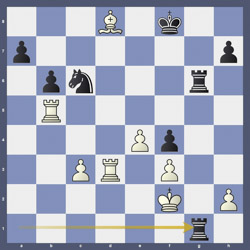
Hoffer (in The Field of 10 August and afterwards in The Chess-Monthly, September pp.18-19) said that this was the end of the game, as did the Deutsche Schachzeitung (August 1895) pages 237-238. This, in our opinion, is really one source not three independent ones, because Hoffer's magazine just repeated what he had said in his column and the Schachzeitung followed The Field.
Everybody else says Lasker gave the spite check on f5 before abandoning. Cheshire (pp30-31) and Pickard end 56 Rf5+ Ke8 0-1. BCM September 1895 (pages 397-399) also said White resigned after Black’s 56th move while The Times of 10 August had 56...K-K sq “and wins." Renette’s recent Lasker biography also ends at move 56, citing the Deutsches Wochenschach for 18th August which stated that White gave the game up after Black’s 56th move.
Conclusion: It is far from clear where Schallopp found the extra move pair 57 Bg5 R6xg5 (which is in Britbase and the Crouch & Haines edition too). It was almost certainly not played, and should be deleted. The 55-move version is probably incorrect too.
The score of this game in ChessBase’s Mega Database is as follows: 1.e4 e5 2.Nf3 Nc6 3.Bb5 d6 4.d4 Bd7 5.Nc3 Nge7 6.d5 Nb8 7.Ng5 Ng6 8.Qh5 Bxb5 9.Nxb5 a6 10.Nc3 h6 11.Ne6 Qe7 12.0–0 Kd7 13.f4 exf4 14.Bxf4 Nxf4 15.Rxf4 fxe6 16.Rf7 e5 17.Raf1 Kd8 18.Rxe7 Bxe7 19.Rf7 Bf6 20.Qf5 Re8 21.Ne2 Be7 22.Ng3 Nd7 23.Nh5 g6 24.Qxg6 Rf8 25.Ng7 Rxf7 26.Qxf7 1–0.
The issue here is: what was White’s 25th move?
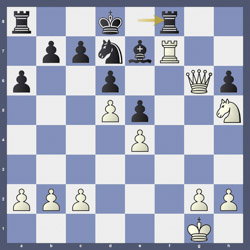
Cheshire (pp.38-39) has 25 Q to Kt7 (i.e., Qg7) with Black resigning after exchanging rooks. The annotator, Teichmann, added a final note that Black “is quite helpless against the threatened Kt to Kt7 or Kt to B6 if the Black knight should move.”
ChessBase follow Schallopp (pp.73-74) which has 25 Sh5-g7 and he was probably following the Deutsche Schachzeitung for September (pages 271-272) which said the same. Both the English magazines (BCM for September 1893, page 386) and The Chess-Monthly (October 1895 page 41) had “Kt-Kt7” (i.e., Ng7). Both Crouch/Haines (p.64) & Pickard copy Schallopp. Urcan’s biography of Pollock seems alone in faithfully copying Cheshire with Qg7.
Conclusion: Both 25th moves win comfortably but 25 Ng7 (which threatens Ne6+) is more forcing and was probably played. The weight of evidence is heavily in favour of the queen move being a misreading by Teichmann of the scoresheet he was given, or perhaps an error by a transcriber if he was given a copy rather than the original.
This series continues by looking at Round 3.