 |
 |
Editor: Dr Tim Harding |
 |
 |
 |
 |
 |
 |
|
|
Editor: Dr Tim Harding |
|
|
|
|
|
|
© Dr Tim Harding
Last modified:
1 November 2026

Round 18 at Hastings was played on the 28th of August 1895.
There are three problem games to be discussed in this round.
The score of this game in ChessBase’s Mega Database 2025 is as follows: 1.e4 e5 2.Nf3 Nc6 3.Bb5 a6 4.Ba4 Nf6 5.0–0 Nxe4 6.Re1 Nc5 7.Bxc6 dxc6 8.Nxe5 Be7 9.d4 Ne6 10.c3 0–0 11.f4 g6 12.Be3 Bd6 13.Nd2 Ng7 14.Ne4 Bf5 15.Ng3 Be6 16.Qe2 Re8 17.Qf2 f6 18.Nf3 Bd5 19.b3 b5 20.Re2 a5 21.Rae1 a4 22.b4 Bc4 23.Rb2 a3 24.Rbb1 Qd7 25.Nd2 Bxa2 26.Ra1 Bd5 27.Reb1 a2 28.Rb2 Ra3 29.Rbxa2 Rxa2 30.Rxa2 Bxa2 31.Nde4 Qf7 32.Nxf6+ Qxf6 33.Qxa2+ Qe6 0–1
The diagram shows the position after White’s 26th move.
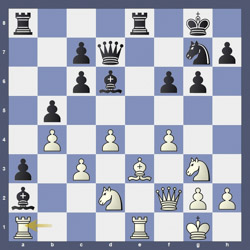
Cheshire (page 278 with notes by Mason) has 26… “B to B5 27 KR to Ktsq P to R7 28 R (Kt2) xP RxR 29 RxR” and Crouch followed with 26…Bc4 27 Reb1 a2 28 Rb2 Ra3 29 Rbxa2.
Schallopp (pages 278-279) has 26…Ba2-d5 saying that he was following the Daily News rather than the English tournament book. We checked and it was in the Daily News of 31st August (page 6). Britbase also prefers 26…Bd5 citing Schallopp and the Newcastle Courant, 14 September 189 but we would be cautious about citing a provincial newspaper two weeks after the event as a primary source. They quite likely copied from the Daily News.
Schallopp also had a note to White’s 27th move explaining that in the English descriptive notation the terms “KR” and “QR” referred to the original placements of those pieces, because after White’s 24th move it was the "king’s" rook on b1 and "queen’s" rook on e1, since they had exchanged places. Victorian chess sets sometimes had markers to show which were the king’s and queen’s rooks and knights.
Conclusion: As Dr Thomas Niessen observed to us: "Cheshire seems wrong [with …Bc4] as White could reply Nxc4" Definitely the English newspapers of the day gave B to Q4 (i.e, Bd5). So we agree that there was a misprint or misreading in Cheshire and that ChessBase has the correct score in this case.
The score of this game in ChessBase’s Mega Database 2025 is as follows: 1.d4 Nf6 2.c4 c5 3.d5 d6 4.Nc3 g6 5.e4 Bg7 6.Bd3 0–0 7.Nge2 Nbd7 8.Nf4 Ne5 9.Be2 b6 10.h4 h5 11.f3 Rb8 12.Nh3 a6 13.a4 Re8 14.Nf2 e6 15.Bg5 exd5 16.Nxd5 Be6 17.Ne3 Qd7 18.Nh3 Nc6 19.Bf4 Bxh3 20.Rxh3 Nd4 21.Bd3 Rb7 22.Kf2 Ne6 23.Bg3 Bh6 24.Nd5 Nxd5 25.cxd5 Nf4 26.Bxf4 Bxf4 27.Bxa6 Be5 28.Bxb7 Bd4+ 29.Kf1 Qxb7 30.Qb3 Ra8 31.Rb1 Qa6+ 32.Qb5 Qxa4 33.Qxa4 Rxa4 34.f4 Rb4 35.b3 c4 36.Ke2 Kf8 37.Kd2 Bf6 38.Re3 c3+ 39.Kc2 Bd4 40.Re2 Rb5 41.b4 f5 42.Kd3 1–0
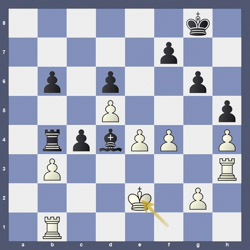
The diagram shows the position after White’s 36th move where a serious discrepancy between sources arises, giving two different plausible king moves. The subsequent moves are the same in both versions.
Schallopp (pages 276-277) had 36…Kg8-f8, repeating Teichmann’s observation that 36…Bc4 would have been a better move, but not noting that the text move was different from the one in Cheshire. Pickard and ChessBase follow Schallopp but he did not say where he found this version. The game was not in either the Schachzeitung or the Wochenschach.
The Cheshire book (pages 279-280), which had notes by Teichmann, says Black played 36 “K to Kt2” (i.e., 36...Kg7). In my book Steinitz in London (game 392 on page 329) I said there are no clear grounds to decide which version is correct but I gave 36…Kg7 in bold type, following both Cheshire and Bachmann’s Schachmeister Steinitz. Both Hooper’s collection of Steinitz games (for the Weltgeschichte des Schach series) and the Crouch/Haines edition of Hastings 1895 also give Kg7 so I was in good company.
However, I have since found that The Times (30 August) had “K to B sq” and this was probably Schallopp’s source.
Conclusion: I now think I made the wrong call here in my book. Since Tinsley played the game and was the chess correspondent of The Times, I think this is a decisive argument in favour of preferring 36…Kf8. (Britbase also gives Kf8 but does so on the basis of a later-date provincial newspaper which probably copied The Times.)
The score of this game in ChessBase’s Mega Database 2025 is as follows: 1.d4 d5 2.c4 e6 3.Nc3 Nf6 4.Bg5 Be7 5.Nf3 0–0 6.Rc1 dxc4 7.e3 c5 8.Bxc4 cxd4 9.exd4 Nc6 10.0–0 Qa5 11.Bf4 Rd8 12.Nb5 Ne8 13.Be3 a6 14.Nc3 Nf6 15.Qe2 b5 16.Bb3 Bb7 17.Rfd1 Nb4 18.Ne5 Rac8 19.a3 Nbd5 20.Nxd5 Nxd5 21.Rxc8 Rxc8 22.Qh5 g6 23.Qf3 f5 24.Qg3 Kg7 25.h4 Qd8 26.Bh6+ Kg8 27.Nxg6 Bf6 28.Ne5+ 1–0
The diagram shows the position after Black’s 18th move where a serious discrepancy between sources arises, about whether White advanced his king’s rook’s pawn or queen’s rook’s pawn.
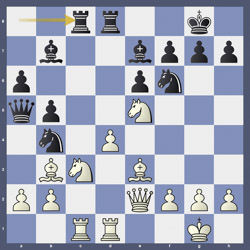
The Cheshire tournament book (pages 284-285) had notes by Blackburne and gives “19 P to KR3”, (i.e, 19 h2-h3), and so did The Times, of 31 August.
Schallopp (pages 277-278) and Crouch (pages 256-257) and Pickard have 19 a3, perhaps because the German editor followed the Deutsches Wochenschach (8th September, page 320) which had 19 a2-a3 with a diagram later in the game that shows the pawn on that square, though this is inconclusive because in the meantime the h-pawn had advanced to h4. Crucially, The Field, 7 September 1895 published only moves 21-end but its diagram shows clearly it is the h-pawn not the a-pawn that was moved.
ChessBase follows Schallopp as usual. Britbase says 19 a3 “seems more logical.” But we do not agree. It is true that the move attacks the knight which then moves to d5, but Black was not threatening anything and 19 h3 is a sensible waiting move, safeguarding against back rank issues later.
Conclusion: Two generally reliable English primary sources (The Times and The Field) both support the Cheshire version. So we believe that this one can be decisively settled in favour of 19 h3 ; ChessBase and Britbase should change their versions.
This series continues with Round 19 and onwards...
 Back to the index (introduction) page for the series.