 |
 |
Editor: Dr Tim Harding |
 |
 |
 |
 |
 |
 |
|
|
Editor: Dr Tim Harding |
|
|
|
|
|
|
© Dr Tim Harding
Last modified:
26 October 2026

Round 13 at Hastings was played on the 21st of August 1895.
There was only one problem game to be discussed in this round but it is a tricky one.
The score of this game in ChessBase’s Mega Database 2025 is as follows: 1. e4 e5 2. Nf3 Nc6 3. Bb5 a6 4. Ba4 Nf6 5. O-O Nxe4 6. Bxc6 dxc6 7. Qe2 Nc5 8. d4 Ne6 9. dxe5 Bc5 10. Rd1 Qe7 11. Nc3 O-O 12. Ne4 Bb6 13. Ng3 f5 14. c3 Bd7 15. Qc2 Nd8 16. Bg5 Qf7 17. Qd3 f4 18. Qxd7 fxg3 19. hxg3 Qg6 20. Qd2 Ne6 21. Be3 Nc5 22. Qe2 Kh8 23. Qc4 1-0
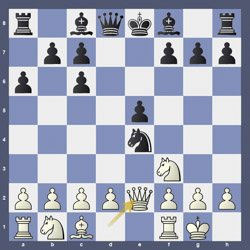
The diagram shows the position after White's 7 Qe2. The question is what was really Black's reply in this short game.
When Dr Thomas Niessen, several years ago, sent me his list of problem games in Hastings 1895 it did not include Walbrodt-Von Bardeleben, apparently because all the databases he tested gave 7…Nc5 (as above) so his comparison software did not detect any issue with this game.
In the official Cheshire tournament book (pages 212-213) the move 7 “Kt to Kt4” (i.e., 7…Ng5) was printed. The English algebraic equivalent of the move in ChessBase’s version is “Kt to B4” or (modernised) “N-B4”. Since the Black knight then goes to K3 (e6) next move, there are no obvious knock-on effects from the discrepancy.
The annotator was Schiffers, who wrote that Black “should play Kt to B3” (i.e., 7…Nf6) and also that “Kt to QB4 followed by Kt to K3 is to be found in the books.”
This game was not published in Schlechter’s column or in the Deutsche Schachzeitung, but it was in the Deutsches Wochenschach (1st December, pages 419-420) with notes by Dr. Tarrasch, and in that version Black’s move was given as Se4-c5 (i.e., Nc5) and also with the comment that it would be better to play the knight to f6. ChessBase and other databases apparently have accepted this version.
Schallopp actually wrote the following note to 7…Ng5, which I give here in the original German and with my translation.
“So verzeichnet das engl. Kongressbuch, und Schiffers bemerkt daselbst, das Se4-f6 besser sei, sowei dass Se4-c5-e6 sich in der Büchern finde. Wir vermuten jedoch, das ein Schreibfehler vorliegt, und das in Wirklichkeit Se4-c5 geschehen ist. Den Se4-g5 hätte Weiss wohl am stärksten mit 8. Sf3xg5 Dd8xg5 9.d2-d4 beantwortet, während andererseits nach Se4-g5 8. d2-d4 Schwarz den Abtausch auf f3 nebst Dd8xd4 schwerlich underlassen haben würde.”
The translation is as follows:
“This is how the English Congress book records it, and Schiffers notes there that Ne4-f6 would be better, while Ne4-c5-e6 is found in the books. However, we suspect that there is a typographical error and that in reality Ne4-c5 occurred. White would probably have responded most strongly to Ne4-g5 with 8. Nf3xg5 Qd8xg5 9. d2-d4, while on the other hand, after Ne4-g5 8. d2-d4, Black would hardly have refrained from the exchange on f3 along with Qd8xd4.”
Conclusion: Schallopp’s argument from the internal evidence is most convincing. As he said, after 7...Ng5 White would surely play 8 Nxg5 Qxg5 8 d4 - and not 8 d4? which blunders a pawn to 8...Nxf3+ and 9...Qxd4. Therefore databases are surely correct to show 7…Nc5 although this is not the move in the Cheshire book. The “typographical error” he supposes cannot, though, have been at the final stage of printing the book, but rather in the copy of the game given to Schiffers, who appears to have been somewhat puzzled about the 7th move but did not wish to alter the score he was given to annotate.
This series will continue soon with Round 14 and onwards...
 Back to the index (introduction) page for the series.