 |
 |
Editor: Dr Tim Harding |
 |
 |
 |
 |
 |
 |
|
|
Editor: Dr Tim Harding |
|
|
|
|
|
|
© Dr Tim Harding
Last modified:
24 October 2026

Round 10 at Hastings was played on the 17th of August 1895. This was the day that Steinitz, after a run of bad results, played his immortal brilliancy against Von Bardeleben who unsportingly left the playing hall rather than see checkmate administered at the board.
This round ended the second week of play. There were three games where the sources disagree on how exactly they ended. The first two do not require diagrams but the third is amusing and also somewhat rather puzzling.
The score of this game in ChessBase’s Mega Database 2025 is as follows: 1.d4 d5 2.c4 e6 3.Nc3 Nf6 4.Bg5 Be7 5.Nf3 b6 6.e3 Bb7 7.Rc1 dxc4 8.Bxc4 Nbd7 9.0–0 0–0 10.Qe2 Nd5 11.Bxe7 Qxe7 12.Nxd5 exd5 13.Bb5 Qd6 14.Rc2 c6 15.Bd3 Nf6 16.Rfc1 Rac8 17.Ba6 Bxa6 18.Qxa6 Rc7 19.Ne5 c5 20.Rxc5 Rxc5 21.Rxc5 Nd7 22.Rc6 Nb8 23.Rxd6 Nxa6 24.Nc6 g6 25.Nxa7 Ra8 26.Nc6 Kg7 27.a3 Rc8 28.g4 Nc7 29.Ne7 Rb8 30.Rd7 Ne6 31.Nxd5 Rc8 32.Nxb6 Rc2 33.b4 Ng5 34.a4 Ne4 35.a5 1–0, which follows Schallopp’s book (pages 177-178).
In the official Cheshire tournament book (page 164) there is a further move pair: “35…Kt x P 36 P to R6 Resigns” (i.e., 35…Nxf2 36 a6 1-0), with an explanatory note by Teichmann to the 36th move. Schlechter’s column does not help with this one as he stopped the game earlier saying White won.
In The Field Hoffer described this as “a dry game in which Mason made no stand at all,” so it is unsurprising that it was not included in the magazines we checked or in the book Pillsbury’s Chess Career, so we are short of sources on this one.
Conclusion: In the absence of firm evidence to the contrary, we go with the longer (official) version. Schallopp must have had a (probably German) source for the short version but we do not know what it was.
The score of this game in ChessBase’s Mega Database 2025 is as follows: 1.e4 e5 2.Nf3 Nc6 3.Bc4 Bc5 4.b4 Bxb4 5.c3 Ba5 6.Qb3 Qf6 7.0–0 Bb6 8.d4 exd4 9.e5 Qg6 10.cxd4 Nxd4 11.Nxd4 Bxd4 12.Nc3 Nh6 13.Be3 Bxe5 14.Bxh6 Qxh6 15.g3 0–0 16.Rfe1 d6 17.Rac1 c6 18.Qb1 b5 19.Bd3 Bb7 20.Nd1 a6 21.Ne3 c5 22.Nf5 Qf6 23.Be4 Bxe4 24.Qxe4 Rae8 25.Kg2 Re6 26.Qg4 Rfe8 27.Rc2 Qg6 28.Qf3 h5 29.Rce2 c4 30.Nh4 Qd3 31.Qc6 Bf6 32.Rxe6 Rxe6 33.Rxe6 fxe6 34.Qe8+ Kh7 35.Qxh5+ Kg8 36.Qe8+ ½–½
Cheshire (page 165, with notes by Albin) has one move pair less than the others, finishing “35 QxRP, ch Drawn Game” with the comment “The latter part of the game was rapidly played. Mr. Bird’s trap was ingenious, and he is unequalled at the lightning style.”
Schallopp (page 173) says Black either overlooked the intent of his opponent’s 31st move or was caught in a deception.” His version includes the 35th move of Black and 36th of White shown above.
Conclusion: In this case, trying to decide who was right about the length difference is of little consequence since this was a perpetual check, so we adopt our default position of accepting the Cheshire version when there is no clear evidence to the contrary. Renette’s biography of Bird includes the extra move pair too.
The score of this game in ChessBase’s Mega Database 2025 is as follows: 1.e4 e5 2.Nf3 Nc6 3.Bb5 a6 4.Ba4 Nf6 5.d3 d6 6.c3 Be7 7.Nbd2 0–0 8.Nf1 b5 9.Bb3 d5 10.Qe2 dxe4 11.dxe4 Bc5 12.Ng3 Qe7 13.0–0 Na5 14.Bc2 Nc4 15.a4 Rb8 16.axb5 axb5 17.b3 Nd6 18.Bg5 h6 19.Be3 Bb6 20.Bxb6 Rxb6 21.Qe3 Rc6 22.h3 Nb7 23.Rfc1 Re8 24.Bd3 Nd6 25.Ra5 Ra6 26.Rca1 Rxa5 27.Rxa5 Qd7 28.c4 c6 29.Ra7 Bb7 30.Qe2 bxc4 31.bxc4 c5 32.Qb2 Qc8 33.Nxe5 Qb8 34.Qa1 Nc8 35.Rxb7 Qxb7 36.Ng4 Nxg4 37.hxg4 f6 38.Nf5 Qd7 39.Bc2 Qc7 40.Qa3 Nb6 41.g3 Ra8 42.Qb2 Nd7 0–1, which is as in Schallopp’s book.
The diagram shows the position after White’s 42nd move which is where the discrepancy occurs.
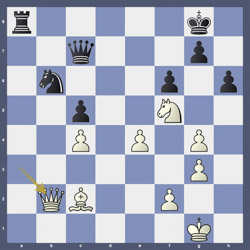
According to the Cheshire tournament book, which had notes by Pillsbury (pages 142-143), there was a move pair omitted. The book gives “42…K to B sq. 43 Q to Kt3 Kt to Q2 44 N-K3” (i.e., 42…Kf8 43 Qb3 Nd7 44 Ne3) whereupon "White exceeded his time and thereupon resigned." If the official book is right, then Schallopp omitted a move pair. Pillsbury said Black was definitely winning in the final position.
Schallopp had an explanatory note on pages 183-183, saying that Tarrasch wrote to him as follows:
"Here I fell asleep — incredible, but true. Twice my opponent called to me: 'Doctor, you must move.' I didn't hear it; finally, the third time, I woke up and quickly made my move 43 Nf5-e3, but the time had already run out. The game was maybe not yet completely hopeless."
The time limit rule in this tournament (see page 7 of the Cheshire book) was that a player had to make thirty moves in his first two hours and fifteen moves per hour thereafter, so the time control was at move 45.
Britbase observes that The Field, 24 August 1895, gives a position with the Black knight on e5 as being the one in which Teichmann claimed the win, so presumably Black played a final half-move (44...Ne5) but in those days the procedures when a game was lost on time were perhaps different from nowadays.
Crouch (pages 160-161) copied the Schallopp version. Pickard gave 42…Kf8 0-1 (time) which cannot be right, because if he was following Cheshire he should have included the extra moves from that book. If Cheshire is right, 42…Kf8 was played and the game continued 43 Qb3 Nd7 and here White lost on time before Tarrasch could complete his move (44) Ne3.
Conclusion: Usually moves made after a game is lost on time do not count for the official score. So the game officially ended after either 42…Nd7 (in Schallopp’s version, accepted by ChessBase) or 43…Nd7 in the official version. But which to believe? Our default is to go with Cheshire's official book.
You can now read Round 11 and (soon) onwards...
 Back to the index (introduction) page for the series.